Gamification in training: what the research says and how to apply it
Points, badges, leaderboards: gamification in training works, but modestly and under certain conditions. What the research says, and how to design a pathway that makes people want to keep going.
 Teaching & digital learningGamify training without gimmicksNews · stakrn-education.com
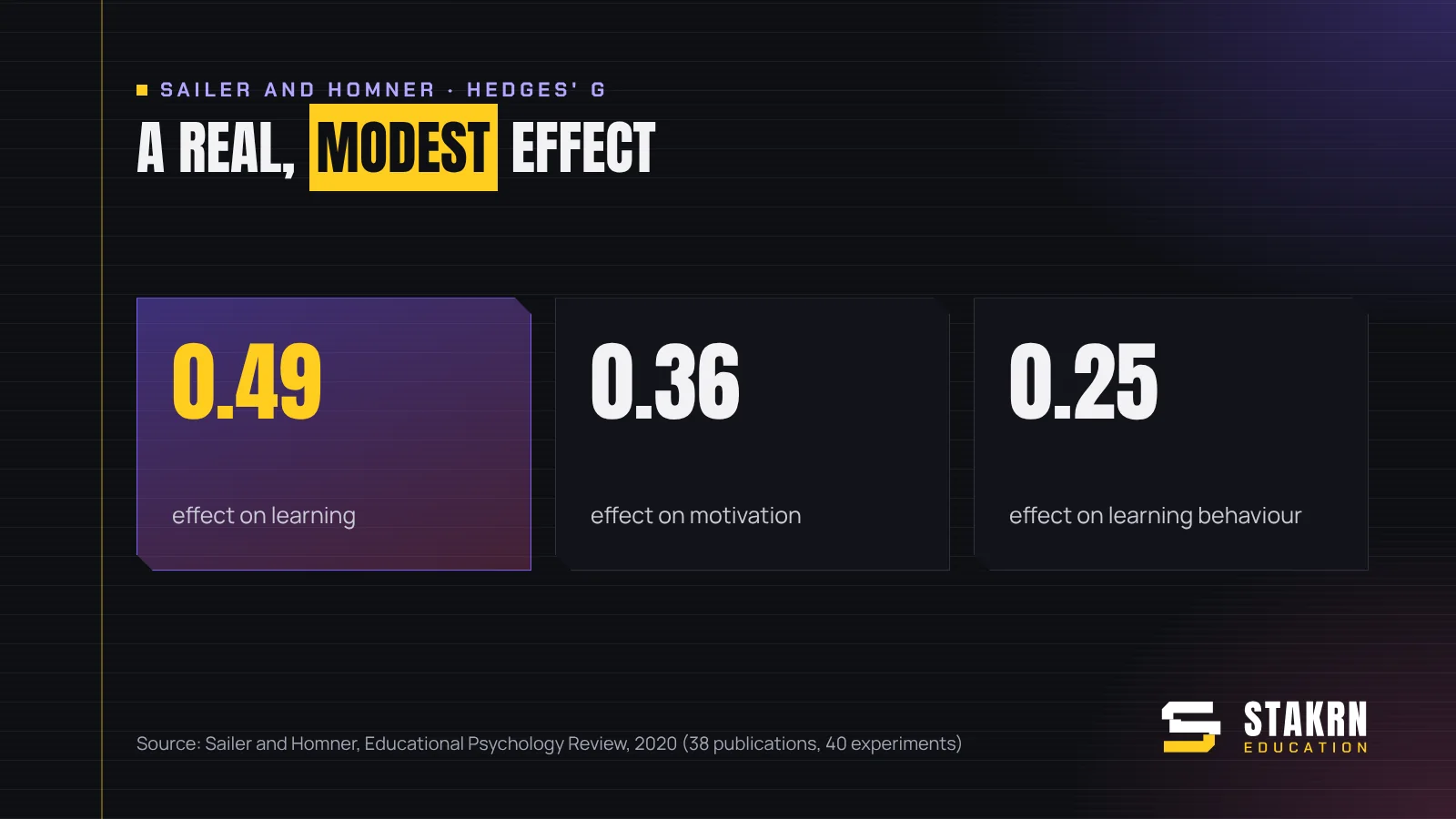
Gamification in training does improve learning, but the effect is modest and depends above all on how it is used. The benchmark meta-analysis, published by Michael Sailer and Lisa Homner in Educational Psychology Review, measures a small to medium gain in knowledge (g = 0.49), and a slightly smaller one in motivation (0.36) and behaviour (0.25). Storytelling and cooperation between learners matter far more than points or leaderboards. For a learning and development team, as for a school, the real question becomes: how do you design a pathway that makes people want to keep going? That is the work we do on our gaming and esports LMS platform, drawing on the gaming culture STAKRN has been part of since 2016.
Gamification in training: what are we talking about?
Gamification means borrowing game mechanics (points, levels, badges, challenges, leaderboards, storytelling) and applying them to an activity that is not a game, in this case a training pathway. It differs from a serious game, a full game designed to teach, and from game-based learning, which uses existing games as teaching material. The three approaches are often combined in the same programme.
This is far from a niche topic. According to the study Les Français et le jeu vidéo, carried out by Médiamétrie for SELL and published in September 2025, 40.2 million people in France played a video game at least once in the year. Adults make up 88% of players and the average age is 40. Most of the employees and students you train therefore already know these mechanics, sometimes better than the people who design their courses. The Fondation Jean-Jaurès sums it up in its study La révolution culturelle du jeu vidéo, released in autumn 2026: video games have become "at once a distraction, a means of escape, a social bond and a way to learn".
What the research actually measures
Three meta-analyses help cut through the sales pitches. A meta-analysis pools the results of many comparative studies and expresses the effect as Hedges' g. By convention, 0.2 is a small effect, 0.5 a medium effect and 0.8 a large effect.
| Study | Scope | Main finding |
|---|---|---|
| Sailer and Homner, Educational Psychology Review (2020) | 38 publications, 40 experiments | 0.49 on learning, 0.36 on motivation, 0.25 on behaviour |
| Li, Ma and Shi, Frontiers in Psychology (October 2023) | 41 studies, 49 samples, more than 5,071 participants | 0.82 on average, with very large differences from one study to another |
| Ratinho et al., Educational Psychology Review (2026) | 45 studies in mathematics, 4,345 school and university students | 0.38 on motivation (11 comparative studies), negative effects in 4 studies |
The most robust result is still Sailer and Homner's: the effect is real, without being spectacular. In higher education, it reaches 0.41 on knowledge. The higher average effect reported by Li, Ma and Shi in Frontiers in Psychology comes with 94% heterogeneity: results vary enormously depending on the design. Well designed, a gamified course can deliver excellent results. Bolted onto unchanged content, it may achieve nothing, or even put learners off.
The review by Ratinho and his co-authors, which focuses on mathematics in secondary and higher education, illustrates this. Of the 45 studies analysed, 4 report negative effects, linked to competition, designs poorly suited to the audience, or rewards unrelated to learning.
Points and leaderboards everywhere, too little story and cooperation
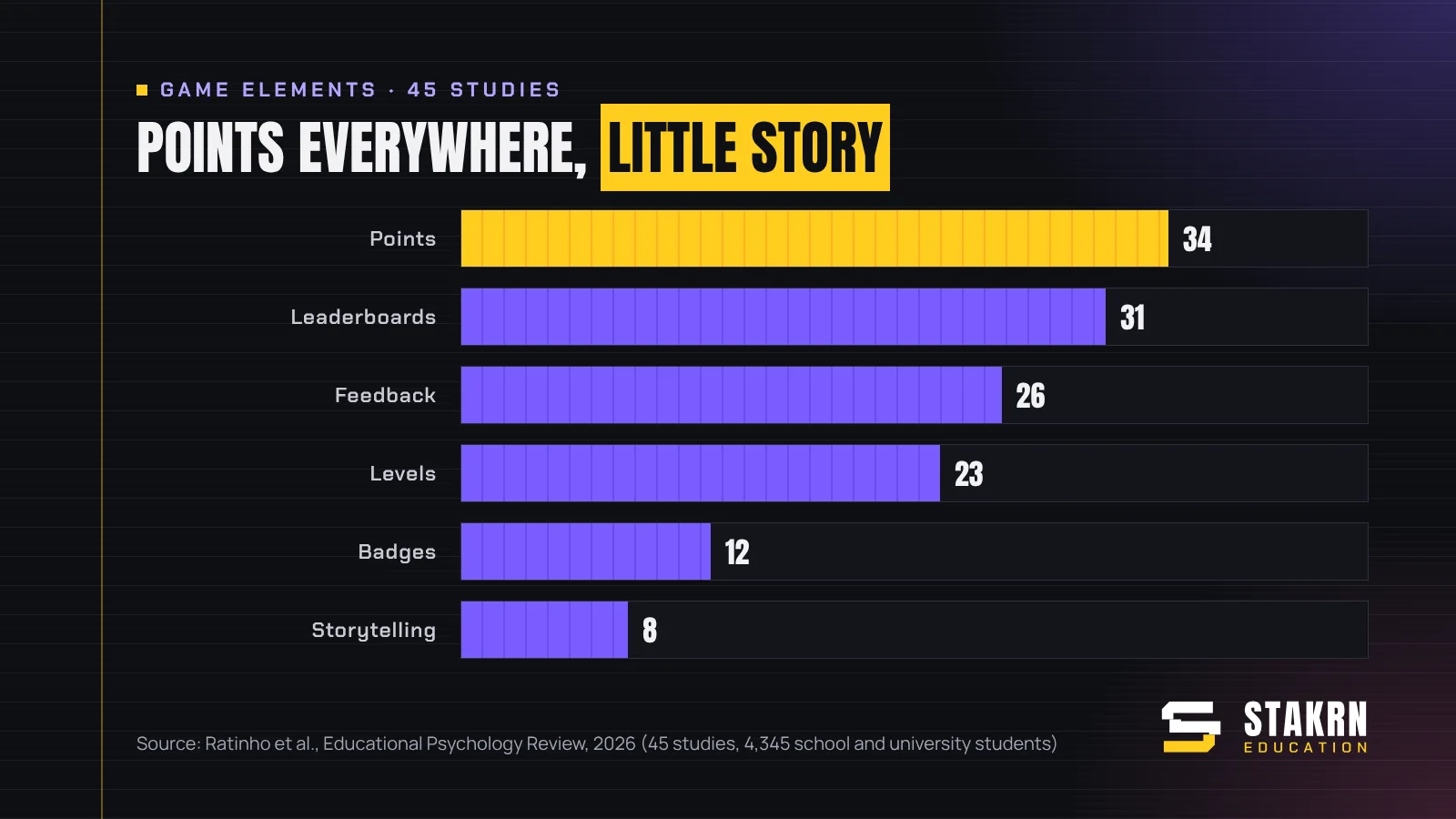
The most common game elements are not the ones with the biggest effect. In the 45 studies reviewed by Ratinho et al., points appear 34 times, leaderboards 31 times and feedback 26 times. Storytelling features in only 8 studies.
Yet Sailer and Homner's data point the other way. On learning behaviour (participation, attendance, effort), designs with a game narrative achieve an effect of 0.41, against a non-significant 0.10 without one. Those that combine competition and collaboration reach 0.70, while competition alone tops out at 0.12, again with no demonstrated effect.
Duration matters too. On motivation, interventions lasting up to six months show an effect of 0.59, against 0.19 for those lasting a day or less. A one-hour gamified workshop livens up a session. It rarely changes the desire to learn over time.
What employees and HR expect: the Cegos 2026 barometer
What learners expect echoes the research. The Cegos Transformations, Skills and Learning barometer, published on 21 April 2026, surveyed 5,524 employees (502 of them in France) and 498 HR or L&D managers (60 in France) across 11 countries in December 2025 and January 2026.
- Real work first: applying learning in real work situations is the top engagement factor, cited by 68% of employees (62% in France) and 70% of HR managers (75% in France).
- Badges matter more to learners: 46% of employees see badges and certificates as a key engagement factor, compared with 33% of HR managers.
- A French taste for play: in France, the playful and interactive side of training is particularly valued, 10 points above the 11-country average.
- A sense of urgency: 41% of employees feel training comes too late.
The classroom is still very present. In France, 63% of training is still delivered face to face, compared with 55% on average. Gamification is not meant to replace it: it sustains engagement between key moments and makes progress visible.
Gamifying a training pathway without gimmicks
A few principles, drawn from these studies and from our own practice, are enough to avoid the most common mistakes.
- Start from the target skill. A badge that rewards logging in teaches nothing. A badge that confirms a case study has been completed gives the employee, and their manager, a clear marker.
- Tell a story. A mission, a season, a business case followed from one module to the next: it is the least used element and one of the most effective.
- Play as a team. Group challenges or team leaderboards motivate more than an individual table where those at the bottom give up.
- Give feedback straight away. Quizzes, role plays and annotated corrections provide immediate feedback.
- Set a rhythm. Several weeks, milestones, and wrap-up sessions face to face or in a virtual classroom.
- Measure. Progress, drop-outs, assessment results. According to Cegos, 42% of HR managers already use learning analytics to improve the learning experience (38% in France).
How we apply it at STAKRN Education
A gamified LMS is only worth having if the mechanics serve the content. Video games have been our field since 2016: more than 100 clients and 250 campaigns in video games, esports and influencer marketing have taught us what brings a player back. Our white-label LMS platform brings together 110 hours of content, including a shared core of 8 programmes (around 70 hours) and 40 hours custom-built, in 6 modules, for each organisation, in French, English or Spanish. Badges and certificates of completion recognise each learner's STAKRN Education pathway, without replacing a qualification.
The 40 custom hours are there for exactly this: with your teams, we build a common thread drawn from your line of work, challenges to tackle together and real-life scenarios. If your organisation already has an LMS, our gaming and esports SCORM modules fit into your existing tool. The teaching, coaching and safeguarding programme helps trainers and supervisors run these schemes, and the video game and esports fundamentals give everyone a shared understanding of how games work. Schools training future professionals in the sector will find the skills to target in our analysis of real career prospects for video game jobs in 2026.
What this means for your organisation
Whether you run training in a company or teaching in a school, gamification deserves better than a veneer of points and trophies. Four concrete decisions to get started:
- Identify the modules in your current pathways with the highest drop-out rates, and start with those.
- Limit the scheme to two or three mechanics, including a story and some form of cooperation.
- Plan for several weeks rather than a one-off event, with key moments face to face.
- Set your indicators from the start: completion, assessment results, learner feedback.
We support companies and L&D teams as well as schools and universities that want to build this kind of pathway, on the LMS platform or through custom gaming and esports training. Tell us about your audience, headcount and goals: we will send you a proposal and a free quote.
Frequently asked questions
What is gamification in training?
It is the use of game mechanics (points, levels, badges, challenges, leaderboards, storytelling) in a training pathway to support learner motivation and engagement. It differs from a serious game, which is a full game designed to teach.
Does gamification really improve learning?
Yes, with a small to medium effect. Sailer and Homner's meta-analysis (Educational Psychology Review, 2020) measures an effect of 0.49 on learning, 0.36 on motivation and 0.25 on behaviour. Designs that include a story and collaboration get the best results.
Should a gamified course include a leaderboard?
Not on its own. According to Sailer and Homner, competition alone has no demonstrated effect on learning behaviour (0.12, not significant), whereas combined with collaboration it reaches 0.70. A team leaderboard, or one based on personal progress, is a better choice.
Can we gamify modules in the LMS we already use?
Yes. Alongside its white-label LMS platform, STAKRN Education offers modules in SCORM format, the standard read by most LMSs, which fit into your existing tool.
Are STAKRN Education badges certifications?
No. STAKRN Education badges and certificates of completion recognise a pathway completed on the platform and make progress visible. They are not official certifications.
Written by the STAKRN Education team
Training for the video game, esports and influence industries since 2016