Video game jobs: real career prospects in 2026 and what schools should be teaching
The games industry is still hiring, but three times less than in 2022 and increasingly through internships. Which video game jobs offer real prospects in 2026, and how schools can adapt their programmes.
 Careers & employabilityVideo games: the real job outlook in 2026News · stakrn-education.com
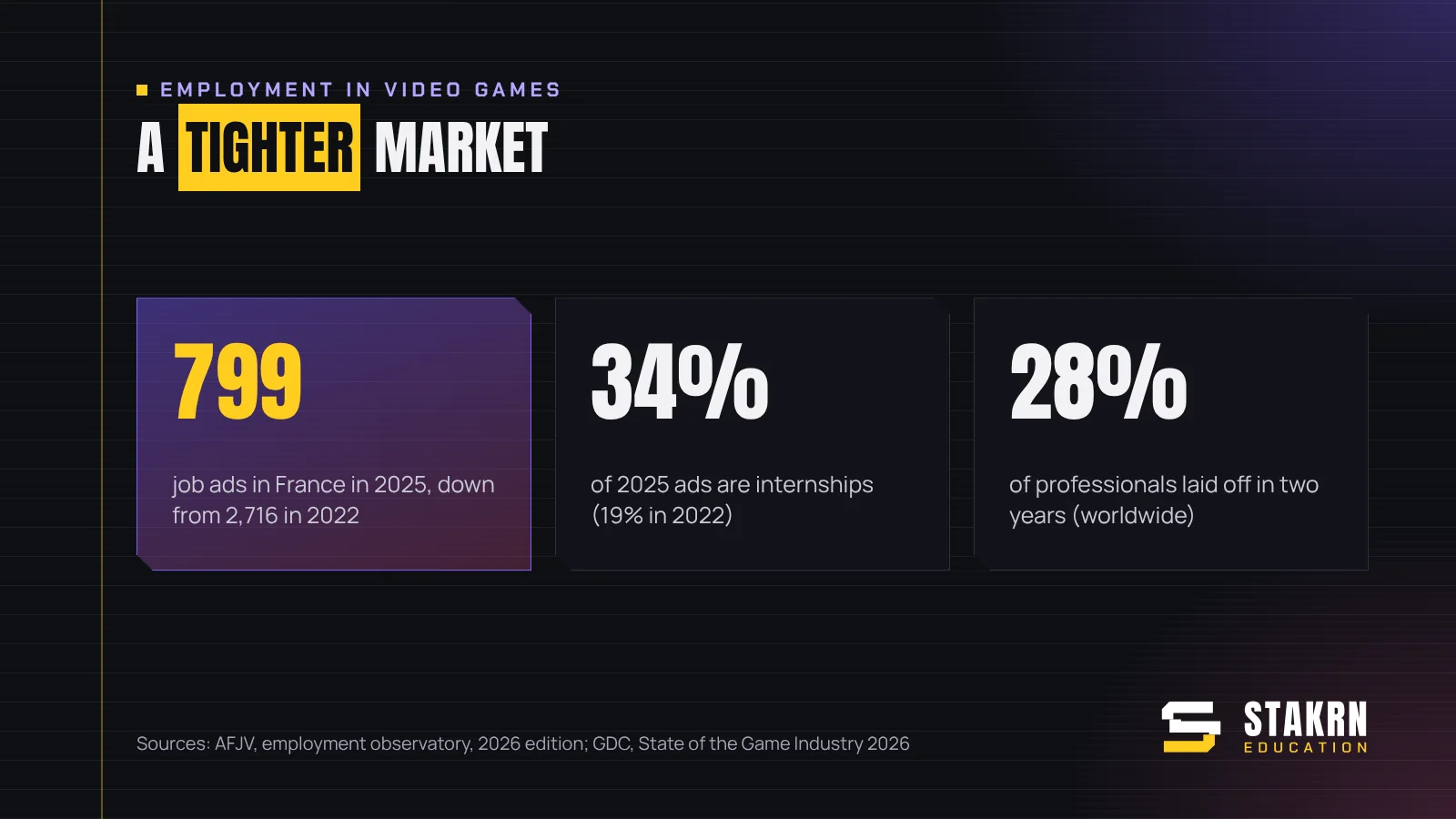
Video game jobs still offer real career prospects in 2026, but in a much narrower market than three years ago: the AFJV counted 799 job and internship ads in France in 2025, compared with 2,716 in 2022. Roles remain concentrated in programming, art and game design, and a third of all ads are now internships. For a school, the question is no longer whether the industry is hiring, but which profiles it keeps. That is exactly what we work on with institutions on our gaming and esports LMS platform: learning pathways that match what studios and neighbouring professions actually expect.
Video game jobs: real prospects in a tighter market
The number of job ads has fallen by 71% in three years. According to the AFJV employment observatory (2026 edition), which gathers almost all job ads published by the sector in France, studios and publishers posted 799 offers for permanent, fixed-term, internship or work-study positions in 2025. The AFJV itself points out that not every hire goes through a job ad, so these figures show a trend rather than an exact number of recruitments.
Other sources confirm the trend. The CNC video game industry barometer, presented on 15 October 2026, is based on a survey of 107 development companies carried out between 16 April and 26 June 2026. On the same day, CNC president Gaëtan Bruel discussed the studio closures and job cuts hitting the sector worldwide in an interview published by the CNC. On the funding side, Économie Matin reports, citing the SNJV barometer, that 31.4% of studios now rely on bank loans, up 7.2 points in a year.
This is not just a French story. The GDC's 2026 State of the Game Industry survey, which polled more than 2,300 professionals, found that 28% of respondents had been laid off in the past two years (33% in the United States). And 74% of the students surveyed said they were worried about their job prospects.
Which video game jobs are still hiring?
Two job families account for more than half of the ads published in 2025. Here is the breakdown recorded by the AFJV:
| Job family | Ads in 2025 | Share |
|---|---|---|
| Programming | 213 | 27% |
| Art (2D, 3D, animation) | 205 | 26% |
| Design (game design, level design) | 96 | 12% |
| Sales and marketing | 82 | 10% |
| Testing and QA | 54 | 7% |
| Production | 47 | 6% |
| Support and community management | 20 | 3% |
| Data management | 13 | 2% |
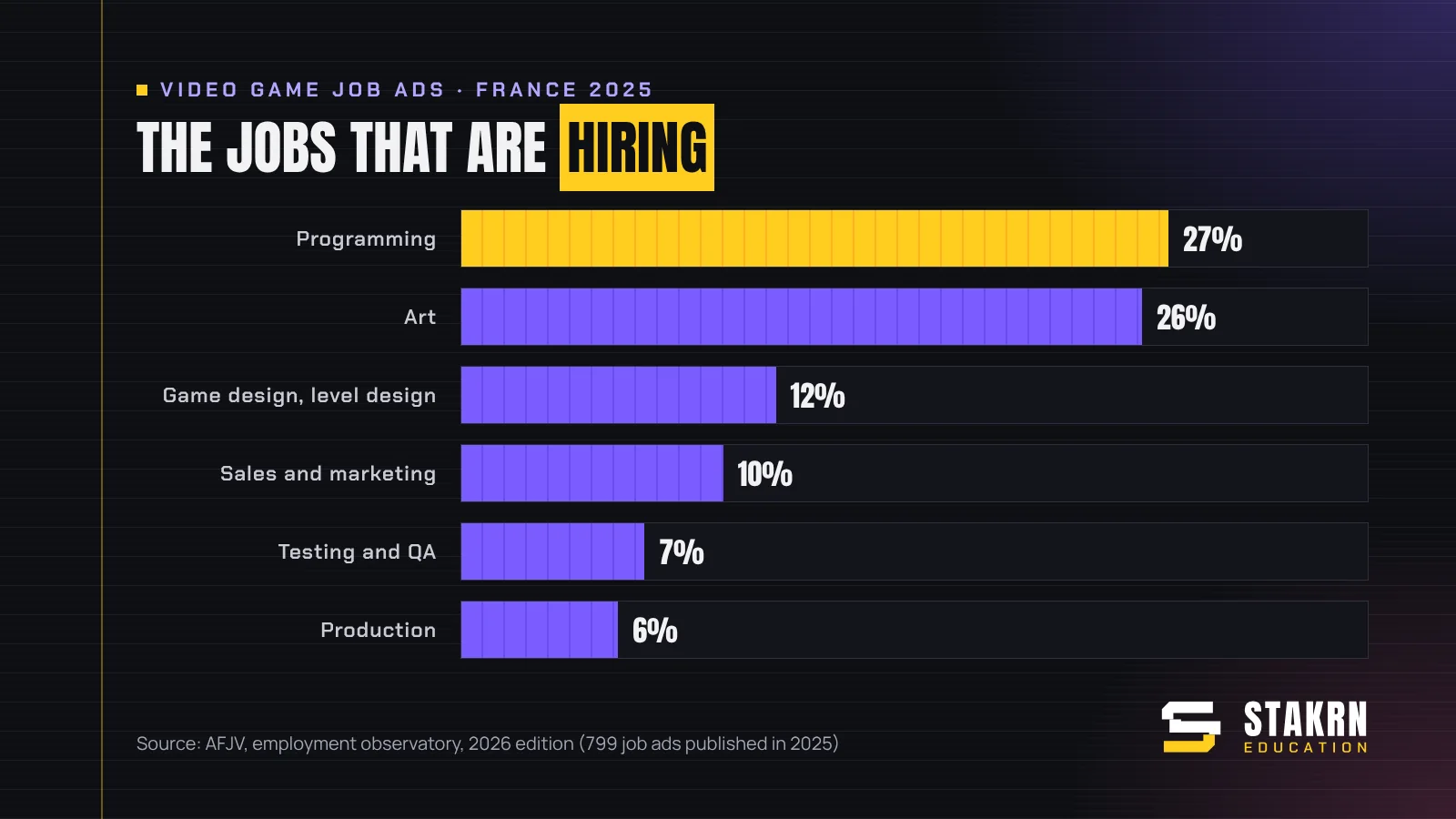
The table also says something about competition. The AFJV counts an average of 117 applications per ad in art, 91 in programming and 71 in design. A 3D art graduate is therefore up against around a hundred other candidates for the same role, often more experienced ones since the waves of layoffs.
Sales and marketing roles make up 10% of ads, more than production or testing. This is often overlooked in programmes focused on creative work: publishing, selling, running a community and working with content creators are video game jobs too, and they open doors to esports and influencer marketing.
Fewer permanent contracts, more internships: getting in has changed
In three years, the internship has become the main way in. According to the breakdown of contract types published by the AFJV, permanent contracts accounted for 60% of ads in 2022 and only 44% in 2025. Over the same period, the share of internships rose from 19% to 34%. Work-study remains marginal, with 33 ads in 2025 compared with 84 in 2022.
- In art, the shift is clear: 57% of ads were for permanent contracts in 2022, 33% in 2025, while internships rose from 17% to 35%.
- In testing and QA, more than one ad in two (56%) is an internship.
- In support and community management, internships reach 75%.
- In programming and game design, permanent contracts hold up better, at around half of all ads.
For schools, the consequence is concrete. A final-year internship can no longer be secured on the strength of a degree or a good art portfolio alone. Studios that hire less pick profiles who can be useful quickly, on a real project, in a smaller team.
The skills that make the difference in 2026
A more selective market rewards profiles who understand the whole value chain, not just their own specialism. That is what we have seen in our work with schools, studios and brands since 2016. Four areas stand out.
Understanding the industry and its business models
A junior who knows how a game is funded, published and sold, what the tax credit is worth or why a studio takes on debt, speaks the same language as their recruiters. Our video game and esports fundamentals programme lays that foundation: players, markets, jobs and the competitive ecosystem.
Working with AI and data
According to the GDC, 36% of games industry professionals already use generative AI tools in their work, while 52% believe it is having a negative impact on the industry. Teaching AI therefore means teaching both how to use it and how to think critically about it. Our AI, data and innovation in video games programme covers both.
Mastering production and teamwork
Project management, agile methods, communication between disciplines: these are cross-cutting skills that studios expect, including from a programmer or an artist.
Opening up to marketing, community and international markets
With 10% of ads in sales and marketing, and more studios self-publishing, knowing how to launch a game, run a community or target a foreign market is becoming an asset for every profile. The international markets and development programme addresses these issues.
Teaching differently: shared core, custom content and an LMS
A school does not need to create an entire degree to improve its students' employability in the games industry. It can complement its teaching with targeted modules that fit into the existing timetable. That is the role of the STAKRN Education LMS platform: 110 hours of white-label content, including a shared core of 8 programmes (around 70 hours) and 40 hours custom-built for each institution, in French, English or Spanish. The catalogue of 8 programmes covers fundamentals, key games, responsible esports, AI and data, international markets, coaching and law.
The 40 custom hours are there to match the school's profile: a business school will focus on publishing, marketing and influencer marketing; an art or engineering school on production, AI and studio work. We build these modules with the teaching team, as part of custom gaming and esports training. Badges and certificates of completion recognise each learner's STAKRN Education pathway, without replacing the institution's own qualification. To make these pathways something learners want to keep going with, we draw on what research says about gamification in training.
What this means for your school
An industry that hires less is not an industry that has stopped hiring. It hires differently, and schools that prepare their students for that reality will stand out. In practice:
- Rethink the careers promise: show students the real prospects, with figures, including jobs in marketing, community, esports and influencer marketing.
- Add a shared grounding in the industry across all specialisms: the economics of video games, funding, publishing, international markets.
- Build AI and data into creative and technical pathways, with a critical eye.
- Prepare the internship as a first assignment: production, teamwork, concrete deliverables.
We support schools and universities that want to build this kind of pathway on the LMS platform, with custom content in their own colours. Tell us about your learners and your goals: we will send you a proposal and a free quote.
Frequently asked questions
Which video game jobs are most in demand in 2026?
According to the AFJV employment observatory (2026 edition), programming (27% of job ads in 2025) and art (26%) remain the two largest job families, ahead of design (game design, level design, 12%) and sales and marketing (10%).
Does the games industry still offer career prospects for new graduates?
Yes, but the market has tightened: the AFJV counted 799 job ads in France in 2025, compared with 2,716 in 2022, and 34% of them were internships. Versatile profiles who understand the industry, production and AI tools have an edge.
Why are there more internships and fewer permanent jobs in the games industry?
Permanent contracts fell from 60% of job ads in 2022 to 44% in 2025, while internships rose from 19% to 34% (AFJV). The shift follows funding difficulties and restructuring across the sector, in France and internationally.
How can a school prepare its students for video game jobs?
By adding a shared grounding in how the industry works, modules on AI, production and marketing, and by preparing the internship as a first real assignment. The STAKRN Education LMS platform offers 110 hours of content, including 40 hours custom-built for each institution.
Written by the STAKRN Education team
Training for the video game, esports and influence industries since 2016